Citrus Fruits: a resource from pulp to peel
Present on our tables since ancient times, citrus fruits represent a category of fruit with a wide range of potential applications.
Originating from India, the Far East and Oceania, the botanical genus Citrus includes several species that share distinctive characteristics: a juice-rich pulp divided into segments, and a particularly aromatic peel.
All citrus fruits derive from three so-called “ancestral” species: mandarin, pomelo and citron. Through the genetic crossing of these varieties, the numerous species commonly consumed today, such as oranges and lemons, have originated.
Today, China, Brazil, the United States and India are among the world’s leading citrus producers, while South Africa is the leading exporting country. Citrus fruits are in fact appreciated worldwide, with fresh consumption ranging from eating the pulp as it is to using juice and peel as ingredients in sweet and savoury preparations.
Yet the potential of citrus fruits goes far beyond this: their composition makes them an extremely versatile raw material for the food industry, from which products intended for different sectors can be obtained.
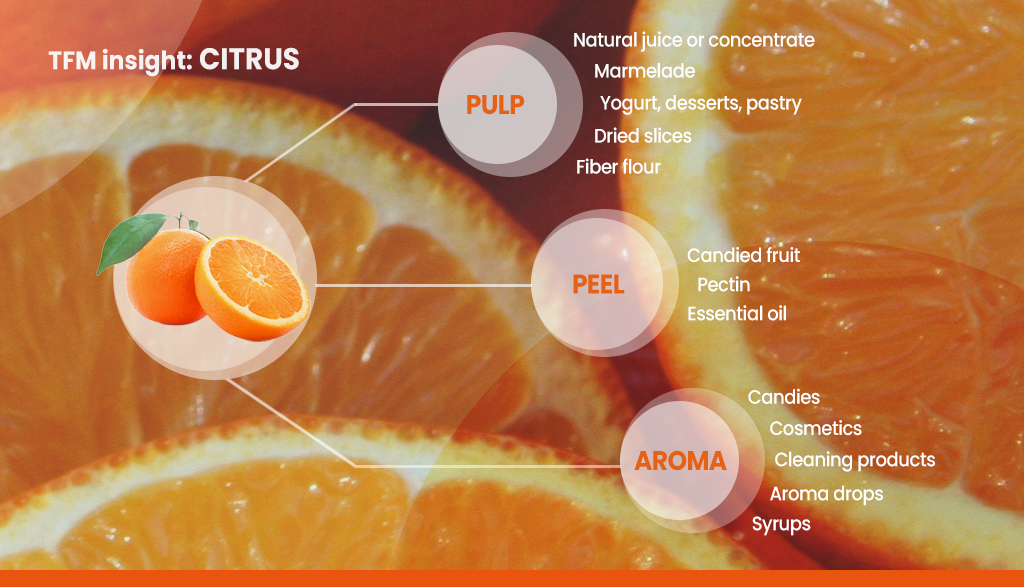
Among the best-known derivatives is orange juice, while lemon juice – particularly rich in citric acid – is used as a natural acidifying and preserving agent in numerous food preparations.
The fruit pulp is also used to produce marmalades and other products, while fibrous residues can be dried and transformed into flours intended, for example, for use as dietary supplements or as ingredients in pet food.
One of the elements that most clearly distinguishes citrus fruits from other fruit families is certainly their peel, which is edible and rich in aroma. Far from being simply a processing waste, the peel is in fact a valuable raw material that can be used for a variety of applications.
Through the candying process, for example, candied peel is obtained, a key ingredient in numerous recipes and gastronomic traditions. Essential oils are instead extracted from the outermost part of the peel and are used in the cosmetic and food industries, while the inner part is recovered for pectin extraction, an ingredient with thickening properties.
Aromas also represent a resource of great interest to industry: during processing, it is possible to recover and concentrate the fruit’s aromatic components, which are subsequently widely used – in addition to the food and cosmetic industries – in the production of detergents and cleaning products, giving them their characteristic fresh and fragrant notes.
Citrus processing therefore makes it possible to valorise every part of the fruit, transforming a single raw material into a wide range of products and opportunities.
Discover our ➤ Fruit processing Lines
Discover our ➤ Aroma Recovery System DIONISO